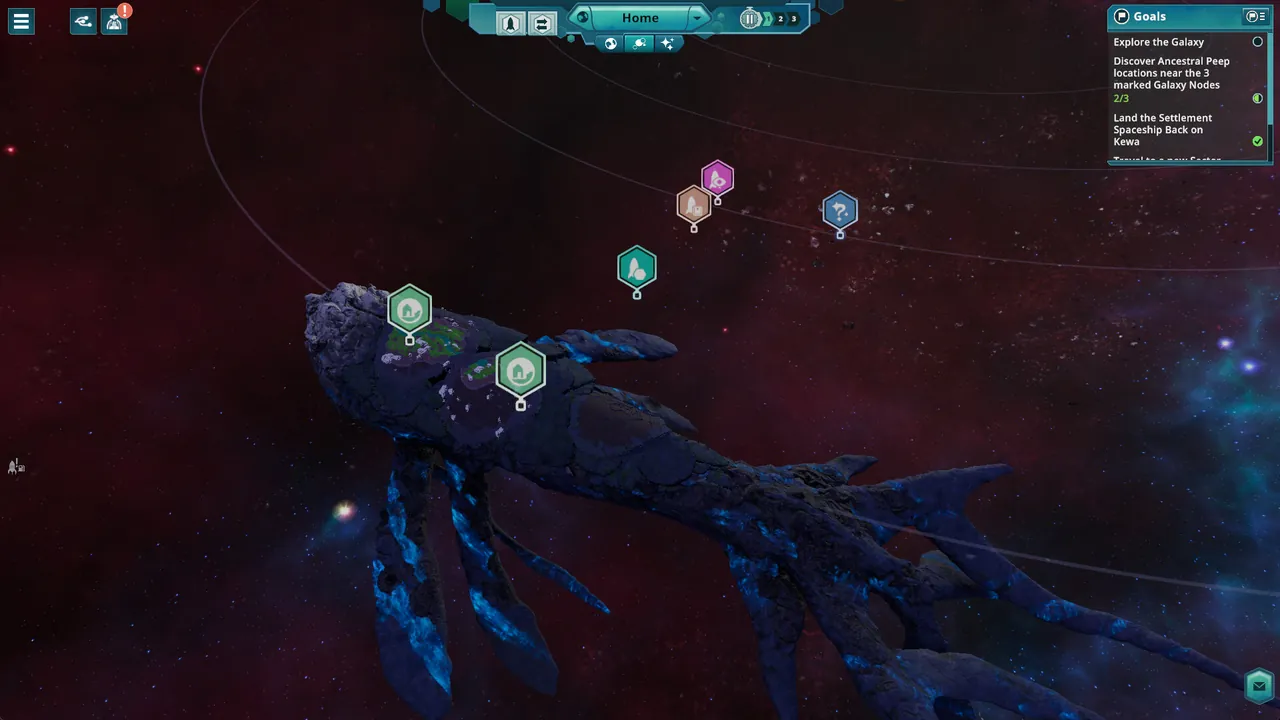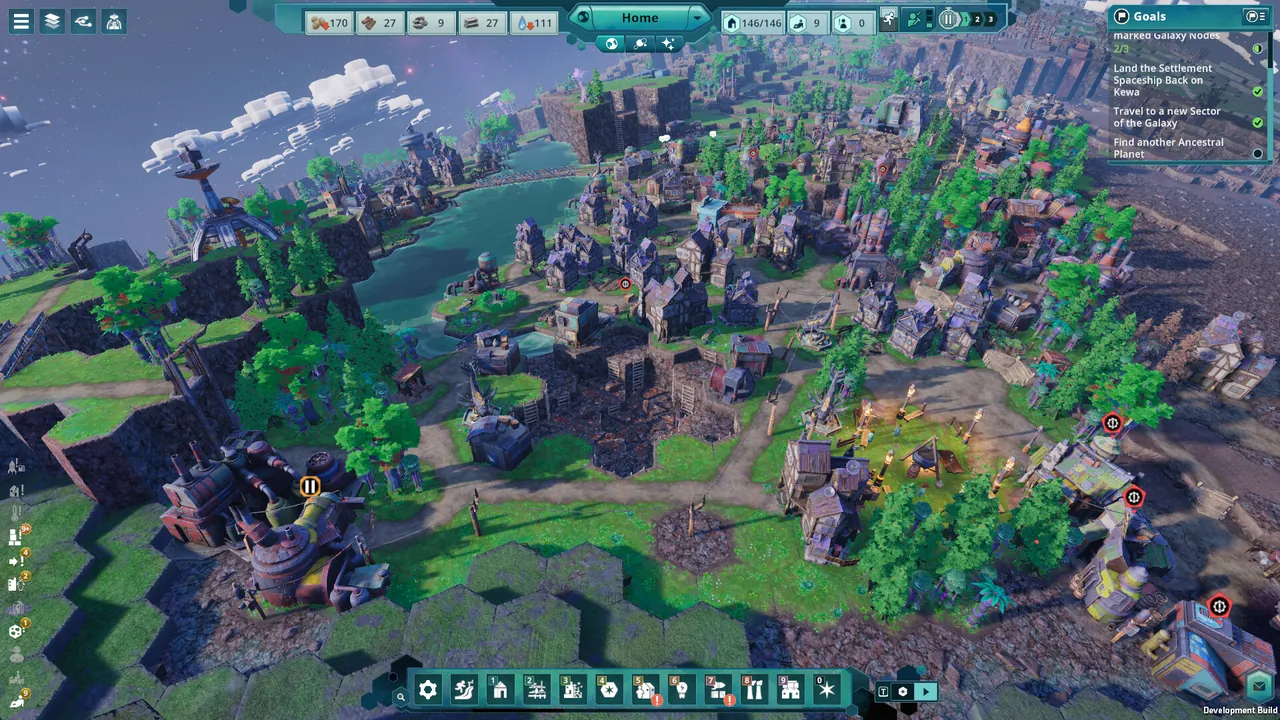
Running out of a resource in Beyond These Stars rarely looks like running out. It usually looks like a smelter idling while a seam sits half a map away, or a build order that stalls because the stone is already mined and sitting in a full store. This page covers how deposits deplete, how to move the mine that worked them, and the checks that separate a real shortage from a storage problem.
Which resources on Kewa can run out?
The official wiki is direct about it: a Mine works deposits of Stone, Iron Ore, Copper Ore and Sand, and the deposit will slowly run out of the resource. Those four are the exhaustible ones in the early game. The settlement also draws on Wood, which is renewable, and later additions to the natural resource list include Copper, Shell and Crystal.
Your starting area is not random in the way it feels. The wiki states that in range of the Home Spaceship there will always be some trees for Wood and one deposit each for Stone and Iron. That guarantee is worth knowing before you panic: the first Stone and Iron you consume came from a deposit that was placed there on purpose.
| Resource | Where it comes from | Exhaustible? |
|---|---|---|
| Stone | Surface deposit, worked by a Mine | Yes |
| Iron Ore | Surface deposit, worked by a Mine | Yes |
| Copper Ore | Deposit, available a little later | Yes |
| Sand | Deposit, worked by a Mine | Yes |
| Wood | Trees; renewable | No |
| Copper, Shell, Crystal | Later natural resources | Not stated |
What do I do when a deposit runs dry?
Move the Mine. The official wiki describes the sequence: once the mine's deposit is empty and the last produced resource has been picked up, you can demolish it or move it next to a different deposit — and it does not have to be the same type of deposit.
That last clause is the part players miss. A Mine is not tied to the material it was built for, so a spent stone pit can be re-sited onto iron without building anything new. Three practical consequences:
- Keep a spare mine rather than a spare district. Re-siting beats opening new ground.
- Expect the move to be the cheap option. Nothing in the wiki suggests moving costs more than the original placement; what it costs is the walk, which leads to the next point.
- Check the 16-tile rule before you commit. Peeps choose a workplace within 16 tiles of their home and will not work further away, though they may walk further to fetch and deliver. A new deposit outside that radius needs housing next to it, not a longer road.
| Situation | Best first move | Why |
|---|---|---|
| Deposit empty, another seam nearby | Re-site the existing Mine | The wiki explicitly allows it, any deposit type |
| Deposit empty, next seam far away | Add housing near the seam | The 16-tile work radius, not the ore, is the constraint |
| Nothing left in the region | Import via Space Port and Trade Ship | Confirmed transport route |
| Shortage is one specific material | Settle a planet that supplies it | Planets exist to fill Kewa's gaps |
| Everything looks supplied but production stopped | Check output storage | A full store halts production exactly like an empty deposit |
Two adjacency effects change how you place the replacement. A Mine next to another Mine gains +20% bonus resources per cycle at the cost of 25% more pollution — which is a real throughput upgrade if you can spare the ground and absorb the smoke. A Mine with one nearby tile underwater gets -25% pollution but runs 20% slower. The pollution guide covers what that pollution then does to the district.
How do nearly-empty deposits get finished?
The official wiki offers a specific late-stage trick: an extra Mine on a deposit, or some extra nearby Storage, can help finish a nearly depleted deposit, and that lets the settlement reclaim the valuable space afterwards through terraforming. In other words, a stubborn last few units are a throughput problem rather than a supply problem, and the answer is to throw parallel capacity at it briefly rather than wait it out.
This matters because mine footprints sit on ground you may want later. The terraforming guide covers reclaiming it; the sequencing point is that finishing the deposit first is what makes the space available.
Does the Landscaper replace a Mine?
No, and the confusion is understandable because both produce a pile of material. The Landscaper reshapes terrain — digging, raising ground, batch area tasks — and its output is Debris. Debris is its own resource, useful for terrain work and as an input to composting through the terraforming chain.
Stone, Sand and the ores are a separate category that only a Mine extracts. A settlement that landscapes aggressively and skips mining ends up with plenty of ground to build on and nothing to build with.
How do imports cover a shortfall?
Imports are a chain of dependencies rather than a button. Trade Ships need landing infrastructure, ordinary ships need Landing Pads, and a Space Port supports up to four pads with one ship per pad at a time. The ships and landing pads guide walks through that capacity model.
There is a strategic caveat the store page states plainly: a weak relationship with Kewa makes its departures harder to predict, and the whale may leave a sector and not return. The sources used here do not establish that trade routes keep working across arbitrary interstellar distances after Kewa moves on, so an outpost that depends entirely on imports is a bet on the whale's mood. The Kewa care guide covers the relationship signals, and the planets and outposts guide covers the settlement side.
What is still unconfirmed?
Worth stating explicitly, because speculation fills this gap quickly:
- Deposit sizes and depletion rates are not published. The wiki says a deposit slowly runs out; it does not say how long one lasts.
- The Blast Mine appears on the official wiki's building list, but no wiki page describes its function.
- Copper Ore and Sand uses beyond the Ore Smelter and construction are not documented in detail.
- Whether deposits regenerate is not stated anywhere in the sources used here.
If a page tells you a deposit holds a specific amount, it is guessing. Plan for depletion by keeping a second seam in reserve rather than by calculating a countdown.
Pro tip: When a line stalls, check the output store before the map. Every building that produces can only hold so many units, and the official wiki notes this applies to by-products as much as main products — a sawmill full of wood waste stops making planks exactly the way an empty deposit stops a mine.
Sources
- Official Hooded Horse wiki, Mine (deposits worked, depletion and re-siting, adjacency effects): https://wiki.hoodedhorse.com/Beyond_These_Stars/Mine
- Official Hooded Horse wiki, Resources (starting deposits, later resources): https://wiki.hoodedhorse.com/Beyond_These_Stars/Resources
- Official Hooded Horse wiki, Storage (output limits, Storage Shed capacity): https://wiki.hoodedhorse.com/Beyond_These_Stars/Storage
- Official Hooded Horse wiki, Peeps (16-tile work radius): https://wiki.hoodedhorse.com/Beyond_These_Stars/Peeps
- Steam announcement, "Dev Blog #28 Settleable Planets": https://store.steampowered.com/news/app/2295060/view/1838407329267634
- Steam store page (outpost reliability, Kewa's unpredictable departures): https://store.steampowered.com/app/2295060/